
In school, from a young age, it’s drilled into you how not to get pregnant, but what they don’t tell you is that one in six Canadians are affected by infertility and getting pregnant may be more difficult than you imagined. So needless to say, I went into this journey completely naive and entirely hopeful.
Back in 2017, during a routine check-up, I made a bold decision: I asked for a referral to a fertility clinic. Being in a same-sex relationship, my partner and I knew this was our starting point. The clinic whirlwind began—tests upon tests, including the notorious Hysterosalpingogram (HSG), which, if you’ve been through it, you know it’s no picnic.
In a surprising turn, during our initial consultation, we learned we were being transitioned to a privately funded clinic because the clinic we were supposed to start in closed its doors to fertility services. Luckily, we got a green light to kick off our journey with IUI. Cue endless nights on cryobank websites, trying to find a donor who felt right.
Amidst this rollercoaster, a friend offered to be our donor—a gesture that still leaves me speechless. We opted for at-home monitoring and kits but after multiple failed attempts, I hit a breaking point. Month after month, the disappointment was crushing.
Fast forward to the end of 2019, and we were back at square one, redoing all those blood tests. Thankfully, my numbers held steady, a small victory at 36. But then 2020 hit, and COVID-19 put everything on hold. Finally, in mid-2020, we started medicated IUI, thinking this was it.
Spoiler alert: it wasn’t. Four medicated IUIs later, with three different donors, and a heart-wrenching chemical pregnancy, I was done. I dove into research, and guess what? Turns out, I had a luteal phase defect that nobody caught.
After another round of tests and a switch to IVF in early 2021, I faced my biggest fear: needles. Zoom injection tutorials became my new normal thanks to the restrictions from the pandemic. Every morning, clinic visits and a date with Wanda–if you know, you know. Every evening, a pep talk in the bathroom mirror before stabbing myself with medication. Thirteen days of this routine before the trigger shot for my egg retrieval—I was a bundle of nerves and incredibly uncomfortable.
The retrieval itself was brutal, and the wait to see how our embryos developed was torturous. When transfer day came, we crossed our fingers and toes and transferred the only two embryos that had made it. I couldn’t wait for the blood test, so I started testing early. And bam, a positive on day five! But the elation was short-lived. A week and a half later, after a bought of bleeding and a lot of panic, our doctor had us in for an ultrasound for viability. Due to the restrictions, my partner wasn’t allowed to come into the scan. I went into it alone and will never forget how cold it was. I remember the doctor, two nurses and a student coming in. I remember the moment the exam started, the tears were streaming down my face because I knew, I just didn’t want to believe it. We got the gut-wrenching news: no heartbeat. The clinic’s response was clinical, to say the least. I was discharged and referred to the Early Pregnancy Loss Clinic and told to call when I was ready to start the next steps.
On March 3, 2021, I miscarried naturally at home. It felt like I was navigating this storm alone, even with my partner by my side. Discovering that one in four women experience pregnancy loss blew my mind. So, to cope, I threw myself into acupuncture, revamped my diet by cutting out all processed sugars, caffeine and dairy, and stocked up on supplements recommended by my acupuncturist—all in preparation for another round of IVF in May.
Round two was "night and day" to the first. More meds, more injections, but surprisingly, less pain. Despite a hiccup during the procedure (my uterus got a surprise perforation), we ended up with seven highly graded-embryos in the freezer. Fast forward to July 6, 2021, we transferred two beautiful embryos. Of course, me being me, I couldn’t resist testing early, and every positive test was a beacon of hope. I got my first positive four days after our transfer.
But pregnancy after loss is a rollercoaster. Early bleeding episodes again had me rushing to the hospital. It felt like I was reliving my nightmare. Turns out, I had a large subchorionic hemorrhage. At six weeks one day, an ultrasound confirmed I was pregnant with twins and got to see their little flickering heartbeats. Weekly ultrasounds started to monitor the SCH. Sure enough, twin pregnancy was not kind to me and I ended up on enough Diclectin to sink a ship just to be able to function through the day. Somedays were so bad I also had to take Zofran just so I could eat. By 23 weeks, I was on modified bed rest, still terrified something was going to happen. At 33 weeks, I ended up being admitted to the antenatal department for observation as I started having contractions and was one cm dilated. They ended up discharging me two days later and sent nurses to my home every other day for stress tests on the babies and testing my blood pressure in case of preeclampsia.
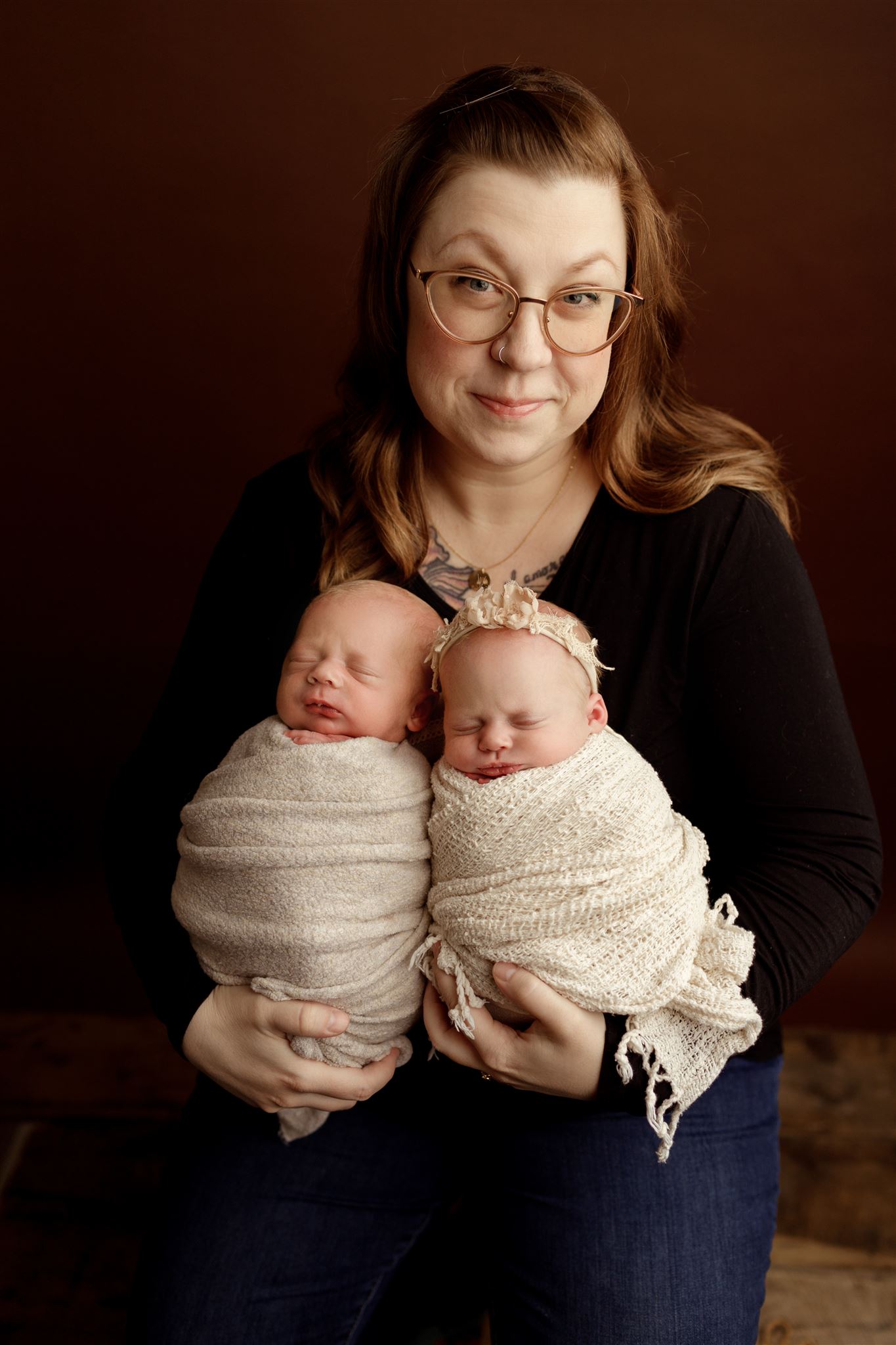
At 34 weeks and six days, I went for a scan to check for intrauterine growth restriction on twin A. That night I started bleeding and was taken to labour and delivery for assessment where doctors decided it was time. I had developed severe preeclampsia and my kidneys were shutting down. Two days later, I was squeezed in for an emergency C-section that ended with multiple blood transfusions, a reaction to morphine and iron infusions every other day. On February 18, 2022, Theodore and Charlotte entered the world, a testament to resilience. Sadly, I barely remember those first days post-birth, lost in a haze of medical intervention.
Yet, through it all, I found strength I never knew I had. Fertility struggles, miscarriage, navigating pregnancy loss—I survived it all. Today, as a single mom, I’m happier than I ever imagined. Yes, the journey reshaped me, but it led me to these two incredible souls who have stolen my heart. And if you’re navigating similar waters, know this: you’re not alone.